ENHANCE “Future learning: Sandbox” at WUT
On January 12, 2026, an event from the Sandbox Experience series took place as part of WP3: Future Learning, which was implemented by WUT within the ENHANCE Alliance.
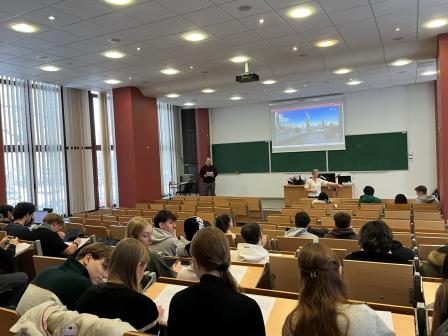
ENHANCE “Future learning: Sandbox” at WUT.
The purpose of the event was to gain a deeper understanding of learners’ needs and preferences regarding the use of new technologies and educational applications. The insights gathered will support the design and deployment of educational technologies that are more closely aligned with the actual needs of students and teachers.
The event was linked to the “Future Learning: Sandbox” task within the ENHANCE+ project, which explores students’ opinions and perceptions of new teaching techniques. It was delivered within the course EPFU (Programming Fundamentals) at the Faculty of Electronics and Information Technology at WUT, within the Computer Science programme taught in English.
The agenda consisted of two main parts. First, Dr Eng. Piotr Pałka delivered an introductory lecture covering the history of computing. This was followed by a guided exploration of the MVP of the virtual museum “Computer History 101”—a VR learning experience that presents the evolution of computers, from ENIAC and the Enigma, through Atari, to modern smartphones and VR headsets. The experience features interactive exhibits, short logic puzzles, and AI-enabled dialogues with Alan Turing, accompanied by selected references that incorporate Polish accents. The virtual world is accessible on both Meta Quest headsets and standard tablets/phones. This segment was facilitated by dr Eng. Anna Sibilska-Mroziewicz from the Faculty of Mechatronics.
In total, 38 students participated: 18 students from Programming Fundamentals and 20 students from the course Career Management in Public Administration. To evaluate the educational impact and capture participants’ perspectives, pre-event and post-event surveys were administered. The survey instruments were prepared by Dr Katarzyna Zambrzycka-Papuda from the Faculty of Administration and Social Sciences and will be used to analyse students’ feedback, attitudes, and perceptions of the applied teaching approach and technology-enhanced learning methods.